
Lunghwa University of Science and Technology Collaborates with Queensland Institute to Share English Instruction and Learning Experiences
To pragmatically promote teaching and learning in the AI era, the Bilingual Education Center of Lunghwa University of Science and Technology and the Australian Office, Taipei, held a visit and lecture by Fiona Wiebusch, founder of The Queensland Institute (QI), Australia, from November 21 to 22, 2024. Through the exchange of activities, both parties explored how to use AI digital tools to promote active learning and shared teachers' practical experience in teaching professional courses in English, hoping to enhance the effectiveness of students’ active learning by applying AI in bilingual teaching.
Fiona Wiebusch, Founder of QI, lectured on “Authentic Learning in the AI Era: Active Learning with Digital Response Tools.” Ms. Wiebusch emphasized that in today's rapid development of AI technology, educators must adapt and apply new teaching methods to improve student learning outcomes. She also delved into how digital tools can inspire and engage students and showcased a variety of interactive learning platforms, including tools such as Padlet and Mentimeter, etc., to give participants a deeper understanding of how to use these tools effectively in the classroom.
After the lecture, the exchange sparked heated discussions and feedback, and many teachers said that they could implement these new concepts in future classrooms and help further promote the application of AI in language teaching, jointly provide students with a more competitive and in-depth educational experience, and create a better and more pragmatic learning environment for students.
Subsequently, Ms. Wiebusch, accompanied by Wei-chih Lien, director of the Bilingual Education Center, observed two courses, "Hospitality Management" by Mei-Ting Hsieh from the Department of Tourism and Leisure, and "Mobile Communication" by Cheng-Yen Chen from the Department of Electrical Engineering. The two professors used English as the medium of instruction in their respective professional courses, demonstrated how EMI can be integrated into teaching, and emphasized the importance of practical operation.
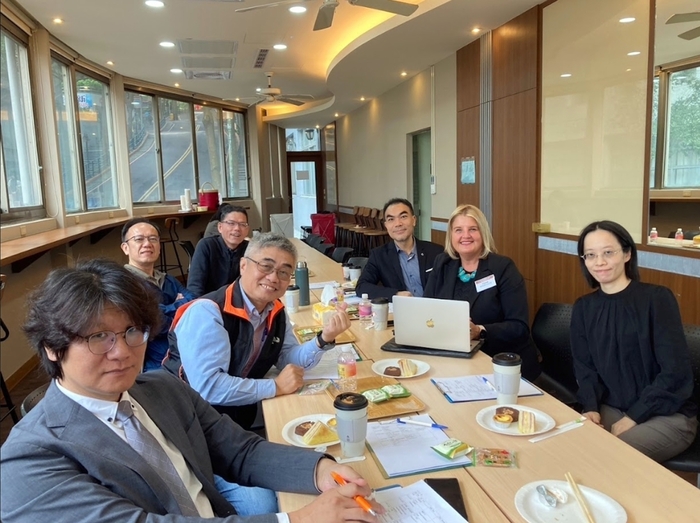
On the second day morning, the students gathered at the Bilingual Education Center for a panel discussion, where Prof. Sheng-Yao Hu from the Department of Electrical Engineering and Prof. Yi-Yun Wang from the Department of Cultural Creativity and Digital Media Design introduced their strategies and challenges in using English in different subjects with "Review of My EMI Courses in LHU" and "My Teaching Experience in the EMI Course" respectively. In the afternoon, Ms. Wiebusch shared her observations and reflections on teaching during the course and lectures. After the event, many teachers expressed their hope that similar activities would be held regularly to improve the quality of education and student learning continuously.
Wei-chih Lien, director of the Bilingual Education Center, said that improving the quality of teaching with the help of AI and ensuring that students truly grasp the culture and context of the two languages when learning bilingualism is a challenge that every teacher must face. This event promotes exchanges between teachers from Taiwan and Australia and allows participants to understand the future direction of EMI teaching in higher education. It also enables educators to jointly explore the application potential of AI technology in education. Also, it provides valuable experience and ideas for the future development of EMI curriculum and teaching.
Secretariat Office, the Lunghwa University of Science and Technology
Contact: LI,CHIANG-SHENG
Office Phone: 82093211#2012
E-mail: lcs222@mail.lhu.edu.tw